[email protected]
+91 97269 26402




7 Signs Your Crop Needs Mix Micro Nutrients (and How Granules Fix It Fast)
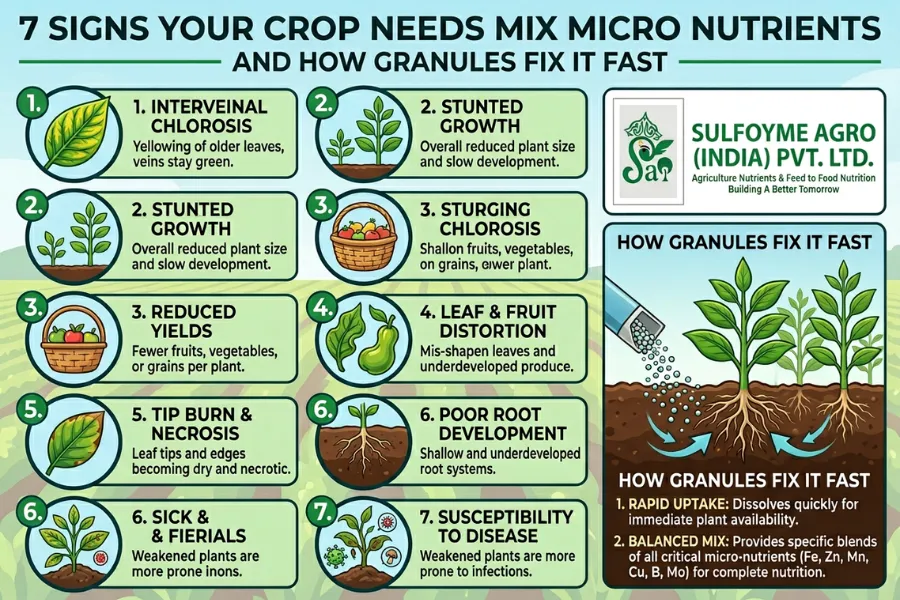
7 Signs Your Crop Needs Mix Micro Nutrients (and How Granules Fix It Fast)
You have done everything right. You watered on time, applied your NPK fertiliser, and protected your crop from pests. And yet something still looks off. The leaves are discoloured. Growth has stalled. Yields are falling short.
The problem may not be what you are giving your crops – it may be what you are not giving them. Micronutrients. These trace elements work silently in the background, and when they are missing, the whole crop system starts to break down.
This is exactly where mixmicro nutrient granules come in. Trusted by farmers across India and formulated to deliver a balanced blend of essential trace elements in a single application, these granules have become a go-to solution for deficiency correction at scale.
Here are seven clear signs that your crop is asking for mix micro nutrients – and how granules can fix the problem quickly and efficiently.
What Are Mix Micro Nutrients and Why Do Crops Need Them?
Mix micro nutrients are blended fertiliser formulations containing two or more essential trace elements – typically zinc (Zn), manganese (Mn), iron (Fe), copper (Cu), boron (B), and molybdenum (Mo) – combined in specific ratios to address multi-nutrient deficiencies in one product.
Unlike macronutrients such as nitrogen, phosphorus, and potassium, micronutrients are needed in tiny quantities. But “tiny” does not mean unimportant. In fact, the absence of even a single micronutrient can disrupt photosynthesis, reduce enzyme activity, impair protein synthesis, and cut yields significantly – sometimes by 20 to 40 percent.
Soils across India – particularly in states like Gujarat, Rajasthan, Madhya Pradesh, Maharashtra, and Punjab – are well known for multi-micronutrient deficiencies, driven by alkaline pH, heavy irrigation, continuous cropping, and low organic matter. This is precisely why demand for a reliable mixmicro nutrient granules manufacturer in India has grown so rapidly in recent years.
7 Signs Your Crop Is Deficient in Mix Micro Nutrients
Do any of these symptoms look familiar? If you spot two or more of the following signs in your field, it is a strong signal that your crop needs a comprehensive micronutrient intervention – not just a single-element fix.
Sign 1: Interveinal Chlorosis on Young Leaves
Young leaves turn yellow between the veins while the veins themselves stay green. This distinctive pattern – called interveinal chlorosis – is one of the earliest and most reliable visual signs of micronutrient stress.
When zinc, manganese, or iron is deficient, the plant cannot produce enough chlorophyll in the areas between leaf veins, leading to this signature yellowing. In maize, it appears as pale streaks on young leaves. In paddy, it shows up as yellowish-brown spots. In wheat, entire tillers may pale out.
Sign 2: Stunted Growth and Shortened Internodes
If your plants are significantly shorter than expected for their growth stage, and the gaps between leaf nodes (internodes) are unusually short, this is a classic zinc deficiency symptom – but it is often compounded by simultaneous shortfalls in manganese and copper.
Zinc is critical for auxin synthesis, which is the growth hormone responsible for cell elongation. Without it, plants look bunched, compact, and stunted. You may notice this most starkly in cotton, maize, sunflower, and sugarcane.
Sign 3: Poor or Uneven Flowering and Fruit Set
Micronutrient deficiencies have a devastating effect on reproductive growth. Boron is essential for pollen tube development and fruit set. Zinc improves pollen viability. Molybdenum supports nitrogen fixation in legumes that drives flower initiation.
If your crop flowers poorly, produces misshapen fruits, or shows hollow or malformed seeds, a multi-micronutrient deficiency is very likely the culprit – especially in oilseeds, pulses, fruits, and vegetables.
Sign 4: Dieback of Growing Tips and Shoot Apices
When the newest growth – shoot tips, terminal buds, young leaves – wilts, browns, or dies back while older tissue remains healthy, this is a classic symptom of boron or calcium deficiency, often seen alongside iron and copper shortfalls.
In tomatoes, it appears as blossom end rot. In groundnuts, it is known as “empty pod” syndrome. In cauliflower and broccoli, it causes browning of the curd. In citrus, you may see “hard fruit” – thick-skinned, dry, and juiceless.
Sign 5: Pale, Bleached, or Bronze-Coloured Leaves
When leaves develop an overall pale, bleached, or unusual bronze or reddish-brown colour – particularly across the entire leaf rather than just between veins – iron, manganese, or copper deficiency is often responsible.
Iron chlorosis is especially common in high-pH soils and waterlogged conditions. In paddy, iron deficiency produces a uniform yellowing or bronze sheen. In vegetables and fruit trees, it creates a washed-out pale appearance that is unmistakable once you know what to look for.
Sign 6: Delayed Maturity and Reduced Yield Despite Adequate NPK
This sign is the most frustrating for farmers: you have applied nitrogen, phosphorus, and potassium as recommended, and the crop still underperforms. Delayed maturity, poor grain filling, low test weight, small fruits, or reduced oil content – despite good NPK nutrition – almost always point to micronutrient gaps.
Zinc is directly involved in carbohydrate transport to grain. Manganese supports seed protein synthesis. Copper influences lignin formation and plant structural integrity. Without these, the final step of yield realisation simply cannot happen efficiently.
This is also where choosing a trusted mixmicro nutrient granules manufacturer in India becomes critical. A well-formulated product with the right element ratios and solubility delivers results that simply cannot be achieved with generic or poorly balanced blends.
Sign 7: Soil Test Reports Showing Multiple Low Micronutrient Levels
Sometimes the earliest sign is not in the field at all – it is in the soil test report. If your soil analysis shows two or more micronutrients at critically low levels (for example, zinc below 0.6 ppm, manganese below 2 ppm, boron below 0.5 ppm), then a multi-micronutrient correction is the most efficient and economical intervention available.
Rather than buying, calculating, and applying four separate fertilisers, a single application of mixmicro nutrient granules addresses all deficiencies together – saving time, labour, and cost while reducing the risk of application errors.
Key Micronutrients in Mix Micro Nutrient Granules and Their Crop Roles
Nutrient | Key Role in Crops | Deficiency Sign | Most Affected Crops |
Zinc (Zn) | Enzyme activation, auxin & chlorophyll synthesis | Interveinal chlorosis, stunting | Rice, Wheat, Maize, Cotton |
Manganese (Mn) | Photosynthesis, nitrogen assimilation | Pale leaves, dead patches | Soybean, Pulses, Sugarcane |
Iron (Fe) | Chlorophyll production, electron transport | Overall yellowing, bleached leaves | Paddy, Vegetables, Citrus |
Copper (Cu) | Lignin formation, enzyme systems | Wilting tips, pale young leaves | Wheat, Fruits, Vegetables |
Boron (B) | Cell wall integrity, pollen tube growth | Dieback of tips, poor fruit set | Oilseeds, Pulses, Fruits |
Molybdenum (Mo) | Nitrogen fixation support, enzyme cofactor | Cupping of leaves, pale growth | Legumes, Cauliflower, Tomato |
How Mixmicro Nutrient Granules Fix Deficiencies Fast
The granular form is what sets these products apart from powder and liquid alternatives. Here is why granules work so effectively:
1. Controlled and Even Distribution
Granules can be broadcast uniformly across the field or incorporated into the soil alongside basal fertilisers. Because of their consistent size and weight, they do not drift or clump the way powders do, ensuring each part of the root zone receives an even nutrient supply.
2. Faster Soil Incorporation
When granules dissolve in soil moisture, the micronutrients become immediately available in the rhizosphere – the root zone – where uptake can begin within days. This is significantly faster than coated or slow-release powder forms.
3. Multi-Nutrient Correction in One Pass
Rather than managing four or five separate products, a farmer can apply one measured dose of mixmicro nutrient granules and address the entire micronutrient profile. This reduces input costs, simplifies logistics, and lowers the risk of over- or under-applying individual elements.
4. Compatible with Existing Fertiliser Programmes
Mixmicro nutrient granules can be blended with urea, DAP, or MOP for combined basal application, or used as a standalone top-dress. This flexibility makes them easy to slot into any existing farm input programme without disruption.
Recommended Application Rates for Mixmicro Nutrient Granules
Crop Category | Recommended Dose (Soil Application) |
Cereals (Rice, Wheat, Maize) | 15 to 20 kg per hectare |
Oilseeds (Groundnut, Soybean, Sunflower) | 10 to 15 kg per hectare |
Pulses (Gram, Lentil, Moong) | 8 to 12 kg per hectare |
Vegetables (Tomato, Potato, Onion) | 12 to 18 kg per hectare |
Fruits & Orchards (Citrus, Mango) | 15 to 25 kg per hectare |
Cotton & Sugarcane | 20 to 25 kg per hectare |
Floriculture | 8 to 12 kg per hectare |
Choosing the Right Mixmicro Nutrient Granules Manufacturer in India
Not all mixmicro nutrient granule products are created equal. The quality of a formulation depends heavily on the source materials, element ratios, granule uniformity, and solubility. When evaluating a mixmicro nutrient granules manufacturer in India, look for the following:
- Declared nutrient percentages on the label – a reliable manufacturer will clearly state the exact content of each micronutrient per kilogram of product.
- Water solubility testing – granules should dissolve cleanly and rapidly in water for both soil and foliar use.
- FCO (Fertiliser Control Order) compliance – all fertilisers sold in India must meet the standards set under the Fertiliser Control Order. Always look for this certification.
- Granule uniformity – consistent granule size ensures even spreading and prevents segregation in blends.
- Traceability and batch testing – a quality manufacturer provides batch-specific analysis certificates on request.
- Agronomist support – the best manufacturers offer technical support and dosage recommendations tailored to your soil type, crop, and region.
Preventing Micronutrient Deficiency: Long-Term Best Practices
Correcting deficiencies after symptoms appear is valuable, but preventing them in the first place is always better. Here is what experienced farmers do to maintain healthy micronutrient levels season after season:
- Conduct soil testing every two to three seasons. Regular testing lets you catch emerging deficiencies before they affect yields.
- Incorporate organic matter. Compost and farmyard manure improve micronutrient availability by lowering soil pH and supporting microbial activity.
- Avoid excess phosphate application. Very high phosphate levels can lock up zinc and iron in the soil, creating induced deficiencies.
- Maintain soil pH between 6.0 and 7.0 where possible. Micronutrient availability drops sharply in highly alkaline soils.
- Use mixmicro nutrient granules as part of an integrated nutrient management Micronutrient deficiencies are one of the most under-diagnosed and under-corrected causes of yield loss in Indian agriculture. The seven signs in this guide – from interveinal chlorosis and stunted growth to poor fruit set and unexplained yield shortfalls despite good NPK inputs – are your crop’s way of asking for help.
Mixmicro nutrient granules offer a practical, affordable, and effective answer. A single balanced product, sourced from a quality mixmicro nutrient granules manufacturer in India and applied at the right time and rate, can transform underperforming crops into healthy, high-yielding ones.