[email protected]
+91 97269 26402




What Is Magnesium Sulphate Heptahydrate? Uses, Properties & Benefits Explained
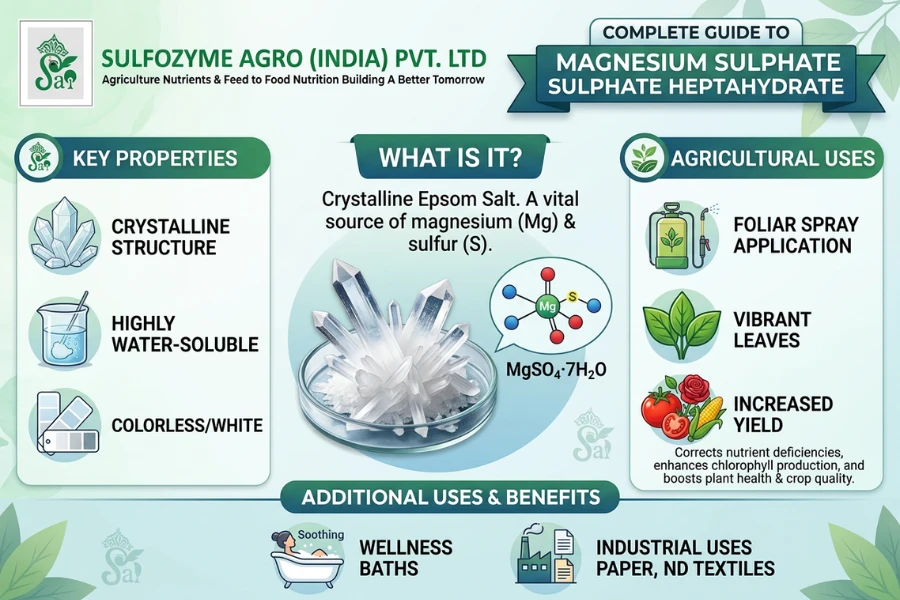
What Is Magnesium Sulphate Heptahydrate? Uses, Properties & Benefits Explained
If you have ever soaked your tired feet in Epsom salt, you have already experienced one of the most versatile compounds in science. That familiar crystal is none other than Magnesium Sulphate Heptahydrate – a mineral compound that touches more parts of our daily lives than most of us realise.
Whether you are a farmer, a healthcare professional, a gardener, or simply someone curious about chemistry, this guide is for you. Let us walk through what this compound is, why it matters, and how it is quietly making a difference across industries.
What Is Magnesium Sulphate Heptahydrate?
Magnesium Sulphate Heptahydrate is an inorganic compound with the chemical formula MgSO₄·7H₂O. In plain terms, it is magnesium sulphate bonded with seven molecules of water – hence the “hepta” (seven) + “hydrate” (water) in its name.
You will most commonly find it sold under the popular name Epsom Salt. It appears as white or colourless crystalline granules that dissolve readily in water. This water-soluble nature is precisely what makes it so incredibly useful across so many fields.
Quick Facts at a Glance
| Property | Detail |
| Chemical Formula | MgSO₄·7H₂O |
| Common Name | Epsom Salt |
| Appearance | White crystalline solid |
| Molecular Weight | 246.47 g/mol |
| Solubility | Highly soluble in water |
| Taste | Bitter, saline |
| pH (1% solution) | ~6.0 – 7.0 (near neutral) |
Key Physical and Chemical Properties
Understanding the properties of Magnesium Sulphate Heptahydrate helps explain why it behaves the way it does – and why industries around the world rely on it.
Physical Properties
- Crystal Structure: It forms monoclinic crystals, meaning the molecules arrange themselves in a specific angular pattern that gives the salt its recognisable granular form.
- Melting Point: At approximately 48.3°C, it begins to lose water molecules – a process called dehydration – long before reaching a true melt.
- Density: Around 1.68 g/cm³, which makes it relatively lightweight and easy to handle in bulk.
- Hygroscopic Nature: It can absorb moisture from the air, which is why proper storage in sealed containers matters.
Chemical Properties
- When dissolved in water, it dissociates into magnesium ions (Mg²⁺) and sulphate ions (SO₄²⁻), which is what drives its biological and industrial activity.
- It is non-flammable and considered chemically stable under normal storage conditions.
- It reacts with strong alkalis to form magnesium hydroxide, releasing sulphate salts in the process.
- In the presence of heat, it progressively loses water molecules, transitioning to anhydrous magnesium sulphate (MgSO₄).
Primary Uses of Magnesium Sulphate Heptahydrate
This compound wears many hats. From hospital wards to farms, from food factories to your bathroom shelf – here is where it truly shines.
1. Agriculture and Crop Nutrition
One of its most important roles is as a magnesium fertiliser. Magnesium is a core component of chlorophyll – the green pigment that allows plants to photosynthesise. Without adequate magnesium, leaves turn yellow (a condition called chlorosis), and yields drop significantly.
Farmers and horticulturists use Magnesium Sulphate Heptahydrate to:
- Correct magnesium deficiency in soils, especially sandy or light soils that leach nutrients quickly.
- Improve germination rates and seedling vigour.
- Boost fruit and vegetable production – tomatoes, roses, peppers, and citrus crops respond particularly well.
- Enhance uptake of other nutrients like nitrogen and phosphorus.
It is also worth noting here that Manganese Sulphate, another micronutrient supplement, is often used alongside magnesium sulphate in balanced crop nutrition programmes. While Magnesium Sulphate Heptahydrate addresses magnesium deficiency, Manganese Sulphate targets manganese deficiency – both of which are critical for healthy enzyme activity and photosynthesis in plants.
2. Medical and Pharmaceutical Applications
In medicine, Magnesium Sulphate Heptahydrate has a long and respected history. Here is how healthcare professionals use it:
- Eclampsia and Pre-eclampsia: It is the gold-standard treatment for preventing seizures in pregnant women with severe hypertension, administered intravenously.
- Asthma: Used as a bronchodilator in acute severe asthma that does not respond to standard treatment.
- Laxative: Oral magnesium sulphate acts as a saline laxative, drawing water into the intestines to relieve constipation.
- Hypomagnesaemia: Used to correct critically low magnesium levels in patients, which can cause cardiac arrhythmias and muscle cramps.
3. Industrial and Manufacturing Uses
Industry has found a wide range of applications for this versatile compound:
- Textile Industry: Used as a fabric-weighting agent and in dyeing processes to fix colour.
- Paper Manufacturing: Acts as a filler and helps improve paper quality.
- Food Processing: Approved as a food additive (E517 in Europe), used as an acidity regulator and firming agent in certain food products.
- Fireproofing: Mixed into certain construction materials to improve fire resistance.
- Chemical Industry: Serves as a drying agent (desiccant) and as a reagent in various chemical reactions.
4. Personal Care and Wellness
This is probably the most familiar use for many people. Epsom salt baths – essentially Magnesium Sulphate Heptahydrate dissolved in warm water – have been a household wellness tradition for centuries.
- Muscle Relaxation: Soaking in Epsom salt is widely used to ease muscle soreness and tension after physical exertion.
- Skin Care: Helps soften skin, and is used in scrubs and foot soaks.
- Stress Relief: Many people find magnesium-rich baths calming, which aligns with magnesium’s role in regulating the nervous system.
- Foot Health: Useful in softening calluses and relieving foot aches.
Health and Environmental Benefits
Beyond its direct uses, Magnesium Sulphate Heptahydrate brings a broader set of benefits worth appreciating.
Human Health Benefits
- Magnesium Support: Nearly 50% of people in developed countries are estimated to be magnesium-deficient. Magnesium sulphate provides a readily bioavailable form of this critical mineral.
- Nervous System Support: Magnesium plays a vital role in nerve transmission and neuromuscular coordination. Getting enough is linked to better sleep, mood regulation, and reduced anxiety.
- Cardiovascular Health: Adequate magnesium intake is associated with lower blood pressure and reduced risk of heart rhythm disorders.
- Anti-inflammatory: Topical and bath use may help reduce localised inflammation, though research is still evolving in this area.
Agricultural and Environmental Benefits
- Reduces reliance on synthetic multi-nutrient fertilisers by providing a targeted, water-soluble magnesium source.
- Can improve soil structure when used correctly, particularly in magnesium-depleted soils.
- Biodegradable and environmentally friendly when used in recommended quantities – unlike many synthetic agrochemicals.
- Paired with Manganese Sulphate in integrated nutrient management, it helps farmers achieve balanced soil nutrition with fewer inputs overall.
Storage, Handling, and Safety Guidelines
Magnesium Sulphate Heptahydrate is generally considered safe, but like any compound, it deserves respect in handling.
- Store in a cool, dry, well-ventilated area, away from moisture (since it is hygroscopic).
- Keep containers tightly sealed to prevent caking and moisture absorption.
- Avoid inhalation of fine dust in industrial settings – use appropriate respiratory protection.
- In medical use, IV administration must be carefully monitored to avoid hypermagnesemia (magnesium toxicity).
- Keep out of reach of children when used in concentrated forms.
Magnesium Sulphate Heptahydrate vs Manganese Sulphate: Key Differences
These two compounds often appear together in agriculture and nutrition discussions, and it is easy to confuse them. Here is a clear, simple comparison:
| Feature | Magnesium Sulphate Heptahydrate | Manganese Sulphate |
| Formula | MgSO₄·7H₂O | MnSO₄ |
| Key Element | Magnesium (Mg) | Manganese (Mn) |
| Role in Plants | Chlorophyll formation, photosynthesis | Enzyme activation, nitrogen assimilation |
| Medical Use | Yes – anti-seizure, laxative | Limited medical use |
| Common Use | Epsom salt, fertiliser, pharma | Micronutrient fertiliser |
| Deficiency Signs | Yellowing between leaf veins | Dead leaf spots, poor growth |
Magnesium Sulphate Heptahydrate might not make headlines, but its quiet contribution to healthcare, agriculture, industry, and personal wellbeing is genuinely remarkable. From helping pregnant women survive eclampsia to helping your roses bloom more vibrantly – this unassuming white crystal does it all.
Whether you are sourcing it for agricultural use alongside Manganese Sulphate, exploring its pharmaceutical applications, or simply curious about what is in your Epsom salt bath, we hope this guide has given you a clearer, warmer understanding of this extraordinary compound.