[email protected]
+91 97269 26402




Zinc content in zinc sulphate monohydrate: why 33% Zn matters for your crops
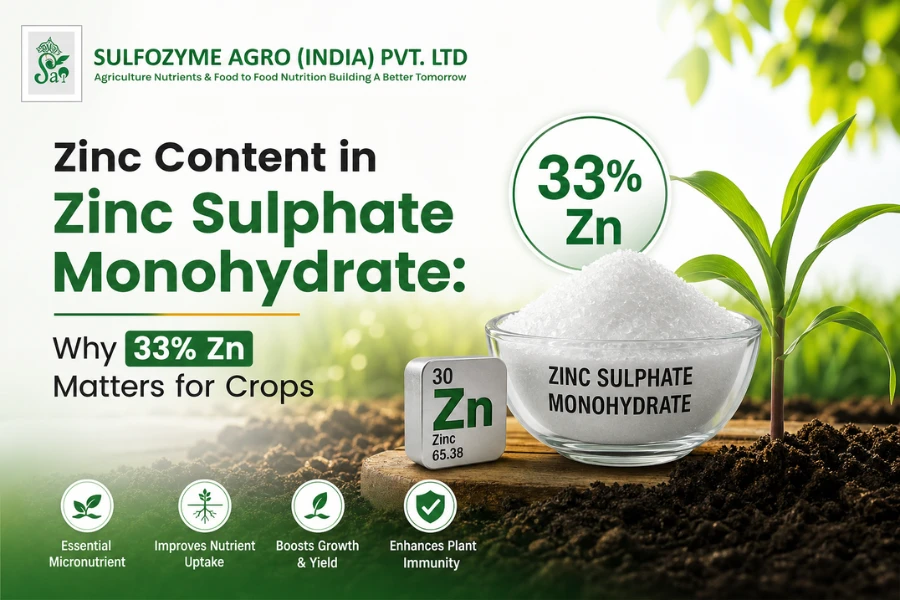
Zinc content in zinc sulphate monohydrate: why 33% Zn matters for your crops
If your crops are growing slowly, showing pale yellow leaves, or simply not yielding what they should – zinc deficiency might be the hidden culprit. And the solution could be as precise as choosing the right zinc content in your fertilizer. Let’s talk about why 33% Zn in zinc sulphate monohydrate is not just a number – it’s the difference between a struggling crop and a thriving one.
What is zinc sulphate monohydrate?
Zinc sulphate monohydrate is a white, free-flowing powder that contains one molecule of water (monohydrate) bonded to zinc sulphate. Its chemical formula is ZnSO₄·H₂O. It is one of the most widely used zinc fertilizers in agriculture and animal feed nutrition worldwide.
What sets it apart from other zinc compounds – including its close cousin zinc sulphate heptahydrate – is its high zinc content of approximately 33%. This concentrated form makes it highly efficient, cost-effective, and easy to handle, store, and apply.
Manufacturers like Sulfozyme Agro India Pvt. Ltd. produce zinc sulphate monohydrate that meets strict quality standards for both fertilizer and feed-grade applications, making it a trusted choice for farmers, agronomists, and feed manufacturers.
Understanding the 33% zinc content - what does it actually mean?
When we say zinc sulphate monohydrate contains 33% Zn, it means that out of every 100 grams of the product, approximately 33 grams is pure elemental zinc. The remaining portion is made up of sulphate (SO₄) and the water molecule.
This matters enormously in practical agriculture. Why? Because you’re not paying for the water or the sulphate – you’re paying for the zinc that your plants or animals actually need. A higher zinc concentration means:
Less product needed per hectare to achieve the same zinc dose
Lower transportation and storage costs
More uniform application, especially in drip irrigation and foliar sprays
Better mixing efficiency when used as part of a mixture of mix micronutrients
Why zinc is non-negotiable for crop health
Zinc is an essential micronutrient – meaning plants need it in small quantities, but they absolutely cannot do without it. It plays a critical role in several key biological processes:
1. Enzyme activation
Zinc activates over 300 enzymes in plants that are responsible for energy production, protein synthesis, and DNA replication. Without adequate zinc, these enzymes simply cannot function, leading to poor cell development and stunted growth.
2. Chlorophyll production
One of the most visible signs of zinc deficiency is yellowing or bleaching of young leaves – a condition called chlorosis. Zinc is essential for the formation of chlorophyll, the green pigment that enables photosynthesis. No chlorophyll, no food for the plant.
3. Hormone regulation and growth
Zinc regulates auxins, which are growth hormones responsible for cell elongation. When zinc levels are low, shoots and internodes become stunted – a classic sign seen in rice, maize, wheat, and citrus crops.
4. Disease resistance
Adequate zinc strengthens plant cell walls and boosts immune responses, making crops more resistant to fungal and bacterial infections. Zinc-deficient plants are not just unproductive – they’re vulnerable.
5. Grain and fruit quality
Zinc is directly linked to the filling of grains, fruit set, and seed viability. Farmers growing paddy, wheat, maize, and pulses often report noticeably heavier and better-quality produce when zinc nutrition is optimised with the right zinc sulphate monohydrate application.
Zinc deficiency in Indian soils - the scale of the problem
India is one of the most zinc-deficient agricultural nations in the world. Studies by the Indian Council of Agricultural Research (ICAR) estimate that over 50% of Indian soils are zinc-deficient, particularly in states like Uttar Pradesh, Punjab, Haryana, Bihar, and parts of Gujarat and Maharashtra.
The reasons are multiple – intensive farming without micronutrient replenishment, alkaline and calcareous soils that lock up zinc, high paddy cultivation (rice is a heavy zinc feeder), and excessive use of phosphatic fertilizers that interfere with zinc uptake.
Why 33% Zn makes zinc sulphate monohydrate the preferred choice
The 33% zinc concentration in zinc sulphate monohydrate hits a sweet spot – it is water-soluble (unlike zinc oxide), highly bioavailable, stable in storage, and versatile enough for soil, foliar, and drip irrigation applications. This is why it dominates both the domestic fertilizer market and export channels.
How zinc sulphate monohydrate fits into a mixture of mix micronutrients
Modern agriculture increasingly relies on balanced nutrition – not just NPK, but a carefully formulated mixture of mix micronutrients that includes zinc, manganese, iron, copper, boron, and molybdenum. Zinc sulphate monohydrate is the backbone of almost every such blend.
Here’s why it blends so well:
- Its free-flowing powder form mixes uniformly with other micronutrient salts
- The 33% Zn concentration allows precise dosing without over-application
- It is chemically compatible with most sulphate-based micronutrients like manganese sulphate monohydrate, ferrous sulphate, and copper sulphate
- It dissolves readily in water, making it ideal for fertigation and water-soluble fertilizer (WSF) blends
For agronomists and fertilizer manufacturers formulating a mixture of mix micronutrients for specific crops or soil profiles, zinc sulphate monohydrate at 33% Zn is the most reliable and cost-efficient zinc source available in India and internationally.
Recommended application methods and dosage
Soil application
For zinc-deficient soils, basal application of zinc sulphate monohydrate at 10–25 kg per hectare (depending on severity) at the time of field preparation is highly effective. The zinc gets incorporated into the root zone before sowing, ensuring availability right from germination.
Foliar spray
For fast correction of visible deficiency symptoms, a 0.2–0.5% foliar spray solution of zinc sulphate monohydrate gives quick results. Apply in the early morning or evening to avoid leaf burn and ensure maximum absorption.
Drip irrigation (fertigation)
Since zinc sulphate monohydrate dissolves completely in water, it is perfect for drip systems. Regular low-dose fertigations (1–2 kg per hectare per application) maintain consistent zinc levels throughout the crop cycle without the risk of localised over-application.
Seed treatment
Coating seeds with a dilute zinc sulphate monohydrate solution before sowing gives young seedlings an early zinc advantage, reducing early-stage deficiency and improving germination rates – especially in zinc-poor sandy soils.
Zinc sulphate monohydrate in animal feed - a bonus benefit
Beyond crops, zinc sulphate monohydrate is equally valuable in livestock and poultry nutrition. Zinc is a critical trace element for animal growth, immune function, reproductive health, and hoof and skin integrity. Feed-grade zinc sulphate monohydrate at 33% Zn is one of the most bioavailable forms of zinc for cattle, poultry, pigs, and aquaculture species.
Its high solubility and precise zinc content make it easy to dose accurately in premix formulations – ensuring animals get exactly what they need without risk of toxicity from over-supplementation.
Frequently asked questions
Q: Is zinc sulphate monohydrate safe for all crops?
Yes. When applied at recommended doses, zinc sulphate monohydrate is safe for all major crops including paddy, wheat, maize, pulses, vegetables, fruits, and plantation crops. Excess application can cause zinc toxicity – always follow agronomist recommendations.
Q: Why is 33% Zn better than lower concentrations?
Higher zinc content means you need less product to deliver the same amount of zinc. This reduces application costs, storage requirements, and logistics – especially important for large farms and bulk buyers.
Q: Can zinc sulphate monohydrate be mixed with urea or DAP?
It can be mixed with urea for soil application, but avoid mixing directly with DAP or SSP as phosphates can precipitate zinc. For foliar use, test compatibility before large-scale application or consult your fertilizer supplier.
Q: How do I store zinc sulphate monohydrate properly?
Store in a cool, dry, well-ventilated area away from moisture. Keep bags sealed and off the ground. Proper storage preserves the 33% Zn content and free-flowing powder form, ensuring consistent quality at the time of use.
When you’re choosing a zinc fertilizer, the percentage of elemental zinc is the single most important number on the label. Zinc sulphate monohydrate at 33% Zn gives you the highest bioavailable zinc in a water-soluble, easy-to-apply format – whether you’re correcting soil deficiency, formulating a mixture of mix micronutrients, or ensuring optimal trace mineral intake in livestock feed.
For farmers battling stunted crops, poor yields, and zinc-deficient soils, the answer is not just more fertilizer – it’s the right fertilizer, with the right zinc content, applied the right way. That’s what zinc sulphate monohydrate at 33% Zn delivers, season after season.
At Sulfozyme Agro India Pvt. Ltd., we manufacture zinc sulphate monohydrate that meets both domestic and international quality standards – ISO certified, Halal certified, and trusted by farmers and feed manufacturers across India and global markets. If you’re ready to give your crops the zinc advantage they deserve, we’re here to help