[email protected]
+91 97269 26402




Zinc Sulfate Monohydrate Specifications Explained for Bulk Buyers
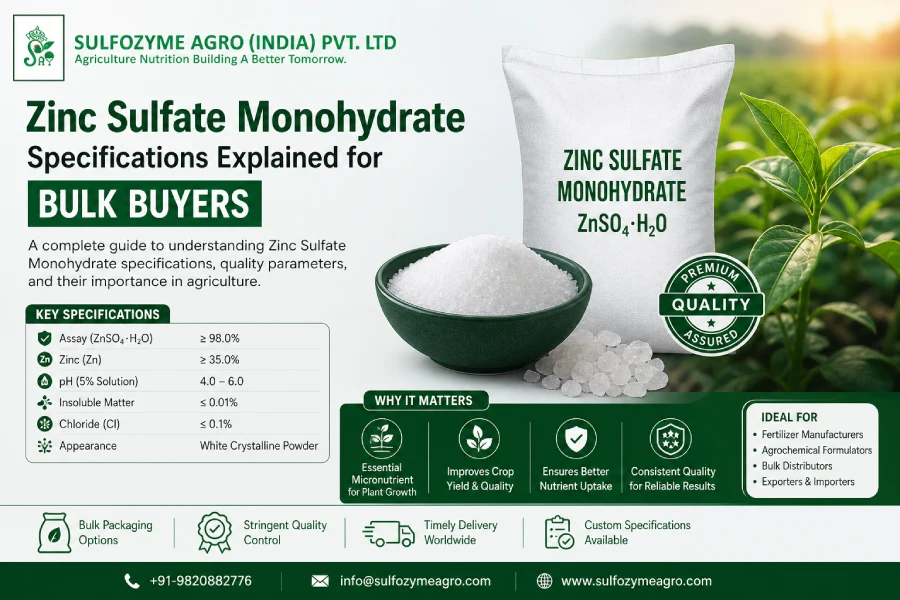
Zinc Sulfate Monohydrate Specifications Explained for Bulk Buyers
A shipment of zinc sulfate monohydrate that looks identical on paper can perform completely differently in the field or on the production line. Two suppliers might both quote “33% zinc,” yet one batch dissolves cleanly while the other leaves sediment in your mixing tank. The difference almost always comes down to specifications that never made it into the sales conversation. This guide walks through what actually matters when you’re sourcing zinc sulfate mono in bulk, so you know what to ask for and what to test before the truck arrives.
Zinc sulfate mono, or zinc sulfate monohydrate, is a white to off-white crystalline compound with the formula ZnSO4·H2O, typically supplying between 33% and 35% elemental zinc by weight. For bulk buyers, the specification sheet should confirm zinc content, moisture level below 1%, heavy metal limits (particularly lead and cadmium), and a particle size range suited to your blending or granulation process. Anything less detailed is a red flag, not a shortcut.
What Zinc Sulfate Monohydrate Actually Is
Zinc sulfate monohydrate forms when zinc sulfate heptahydrate is dried down to a single water molecule per formula unit, which concentrates the zinc content and cuts shipping weight substantially. A tonne of heptahydrate carries roughly 21% zinc, while the same tonne converted to monohydrate carries around 33%, meaning buyers pay less freight per unit of actual zinc delivered.
This concentration step is also where quality control either happens correctly or gets skipped. Manufacturers who rush the drying process end up with inconsistent hydration states within the same batch, which shows up later as clumping in storage or uneven dissolution rates in liquid fertilizer blends.
Sourcing decisions often hinge on whether the supplier controls the drying stage in-house or buys pre-dried crystal from a third party. In-house drying gives more control over batch-to-batch consistency, since kiln temperature and residence time can be adjusted in response to incoming heptahydrate quality rather than accepted as-is.
The Core Specifications That Define Grade
Zinc content is the first number every buyer checks, and reputable suppliers report it as elemental zinc percentage, not as “zinc sulfate percentage,” which reads higher but tells you less. A genuine feed-grade or fertilizer-grade product sits between 33% and 35% zinc, verified by EDTA titration or atomic absorption spectroscopy rather than a supplier’s internal estimate alone.
Moisture content should not exceed 1%, since excess moisture accelerates caking during transport and storage, particularly in humid coastal warehouses. Buyers receiving material through port cities often request a moisture test at both origin and destination to catch condensation damage during shipping.
Heavy metal limits matter most for feed-grade and agricultural applications, where lead is typically capped around 10 ppm and cadmium around 5 ppm under most national feed regulations. Industrial-grade material for uses like rayon production or wood preservatives tolerates slightly wider ranges, but buyers should never assume a lower grade automatically means unsafe limits — it simply means the spec sheet targets a different end use.
pH of a 5% aqueous solution typically falls between 4.0 and 6.0, and a result outside that band often signals contamination from processing residues or an inconsistent raw material source. This single test, run in under ten minutes, catches more supply chain problems than any visual inspection.
Insoluble matter is another line item worth checking, generally kept below 0.05% in good-quality monohydrate. A higher reading usually points to residual gangue material from the original zinc ore or sloppy filtration during crystallization, and it tends to show up as visible grit at the bottom of a mixing tank rather than anything a spec sheet alone would flag.
How Particle Size and Form Affect Your Application
How Does Particle Size Affect Zinc Sulfate Performance in Blending?
Particle size determines how evenly zinc sulfate mono distributes through a fertilizer blend or feed premix, and mismatched sizing is one of the most common complaints bulk buyers raise after the fact. Granular forms, usually 1mm to 4mm, suit bulk blending with other granular fertilizers like urea or DAP because similar particle sizes resist segregation during transport.
Powder or fine crystalline forms, generally under 0.5mm, dissolve faster and suit liquid feed applications or foliar spray formulations. Buyers ordering powder for a granular blend, or the reverse, frequently end up with a product that separates in the bag or in the spreader, which wastes both material and field application accuracy.
Bulk density also deserves a line item on your spec sheet, since it typically runs between 1.0 and 1.3 g/cm3 for standard monohydrate and directly affects how many tonnes fit in a container or silo. A supplier who cannot provide this figure likely hasn’t run consistent quality checks across production runs.
Certifications and Documentation Bulk Buyers Should Request
A Certificate of Analysis, or COA, should accompany every shipment and list the actual test results for that specific batch, not a generic average pulled from a product brochure. Buyers should cross-check the COA batch number against the physical bags or bulk bags received, since mismatched numbers are a common sign of relabeled or blended stock.
For agricultural use, look for compliance with AAFCO standards in the US or equivalent fertilizer control order registrations in the destination country, since these frameworks set enforceable limits rather than voluntary targets. Feed-grade shipments crossing international borders typically also need a phytosanitary or health certificate depending on the importing country’s requirements.
ISO 9001 certification on the manufacturing facility itself is a reasonable baseline indicator of process consistency, though it says nothing about the specific batch you’re buying. Pairing facility certification with batch-level COA testing gives buyers the fullest picture available before payment changes hands.
Storage, Shelf Life, and Handling Once It Arrives
Zinc sulfate monohydrate is hygroscopic enough that it will absorb ambient moisture if stored in unsealed or damaged packaging, gradually reverting toward a higher hydration state and losing its concentration advantage over heptahydrate. Proper storage in sealed polyethylene-lined bags, kept off damp flooring, preserves the stated specifications for roughly two years under normal warehouse conditions.
Buyers receiving jumbo bags or bulk containers should inspect for pinhole tears immediately at unloading, since even small punctures let in enough humidity over a multi-month storage period to cause visible caking by the time the material reaches the blending line. Reworking caked material costs more in labor than the moisture damage saved in shipping.
Temperature swings during transit cause a similar problem even without packaging damage, since condensation can form inside a sealed bag when a container moves from a cold port to a humid destination without ventilation. Buyers importing across long ocean routes should ask suppliers whether containers are vented or desiccant-lined, a detail that rarely appears on a shipping quote but affects final quality.
A Quick Comparison for Buyers Weighing Monohydrate Against Heptahydrate
Factor |
|
| ||
| 33%–35% | ~21% | ||
| Higher zinc per tonne shipped | Lower, more water weight | ||
Solubility | Fast, slightly slower than heptahydrate | Very fast | ||
| Fertilizer blends, feed premix | Liquid formulations, some industrial uses | ||
| Good if sealed | More prone to caking in heat |
Most bulk agricultural and feed buyers now default to monohydrate specifically because the freight savings on zinc content outweigh the marginal solubility edge heptahydrate offers, especially on longer shipping routes.
Frequently Asked Questions
What is the zinc content in zinc sulfate monohydrate?
Standard zinc sulfate monohydrate delivers between 33% and 35% elemental zinc by weight, verified through titration or spectroscopy rather than supplier estimates. Buyers should request the actual test method used on the COA, since some informal suppliers round up from unverified figures.
Is zinc sulfate mono the same as zinc sulphate fertilizer?
Yes, zinc sulphate fertilizer commonly refers to the same monohydrate or heptahydrate compound sold specifically for agricultural micronutrient correction. The spelling difference between “sulfate” and “sulphate” reflects regional convention rather than any chemical distinction.
How long does zinc sulfate monohydrate last in storage?
Properly sealed and stored away from moisture, it retains its specifications for approximately two years. Torn packaging or humid storage conditions can shorten that window considerably, sometimes causing visible caking within a few months.
What moisture content is acceptable for bulk orders?
Moisture should stay under 1% for both feed-grade and fertilizer-grade material, since higher levels accelerate caking and reduce effective zinc concentration over time. Buyers can request an independent moisture test at the destination port as a condition of final payment.
Why do zinc sulfate prices vary so much between suppliers?
Price differences usually track back to purity grade, particle size consistency, and whether the supplier tests every batch versus relying on periodic sampling. A lower price per tonne on paper can cost more in the long run if the actual zinc delivered falls short of the stated percentage.
The next time a quote lands in your inbox listing only price and tonnage, ask for the COA, the moisture figure, and the particle size range before you commit. Those three data points predict whether the zinc sulfate mono you receive performs the way your blending line or field trial expects. Building that request into your standard purchase order turns quality control from an afterthought into a condition of sale.